New Tool: Starrett Micrometer (& unplanned project log)
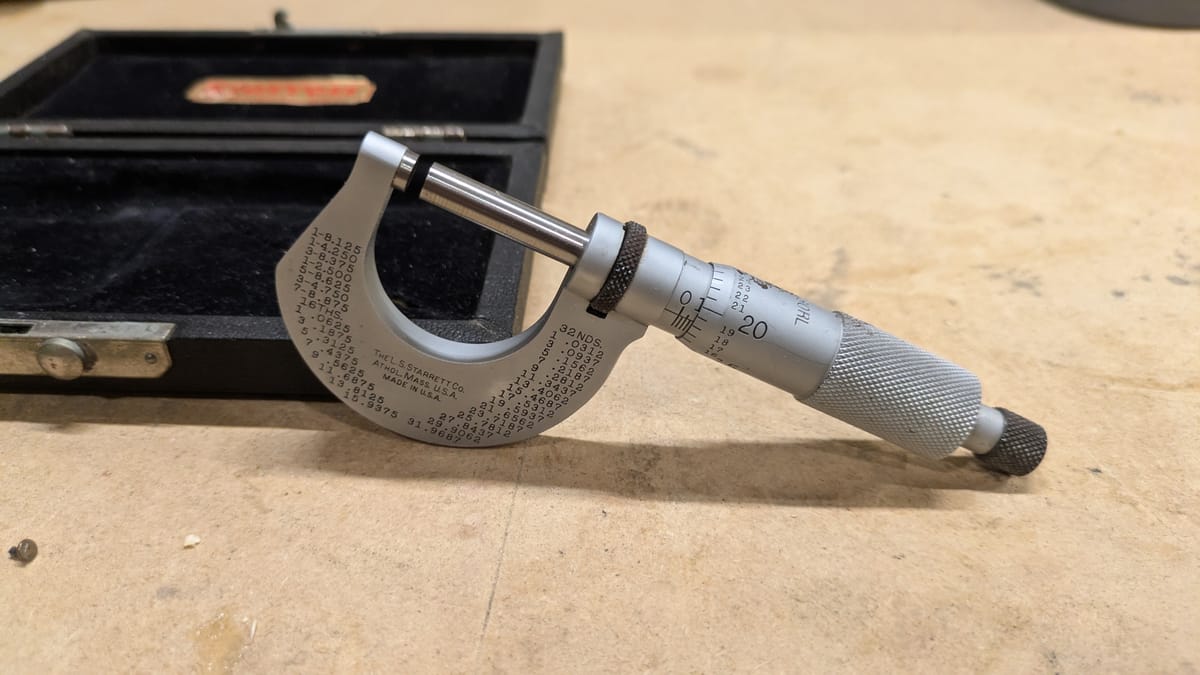
Through a series of events, I ended up bidding on a three-item lot from an estate sale, one of which was a Starrett micrometer. I don't have a strict purpose for a tool like this; the woodworking and 3D printing I do these days do not require precision down to the thousandth of an inch. But I admit being intrigued by Adam Savage's descent into precision and "chasing zeros". I'd never used a micrometer like this, and when a good deal popped up on one, I couldn't resist.
I've never even held a tool like this, but it seemed a sort of token of a bygone era, a pre-digital tool for exceptional precision through clever use of physical materials, the way a set of vernier calipers or a slide rule might be. I have some instinct deep down that there are still lessons to be learned from using manual tools like this, skills and habits to be learned, the same way you benefit from keeping up with writing things down longhand and not relying on typing for anything longer than a Post-It Note.
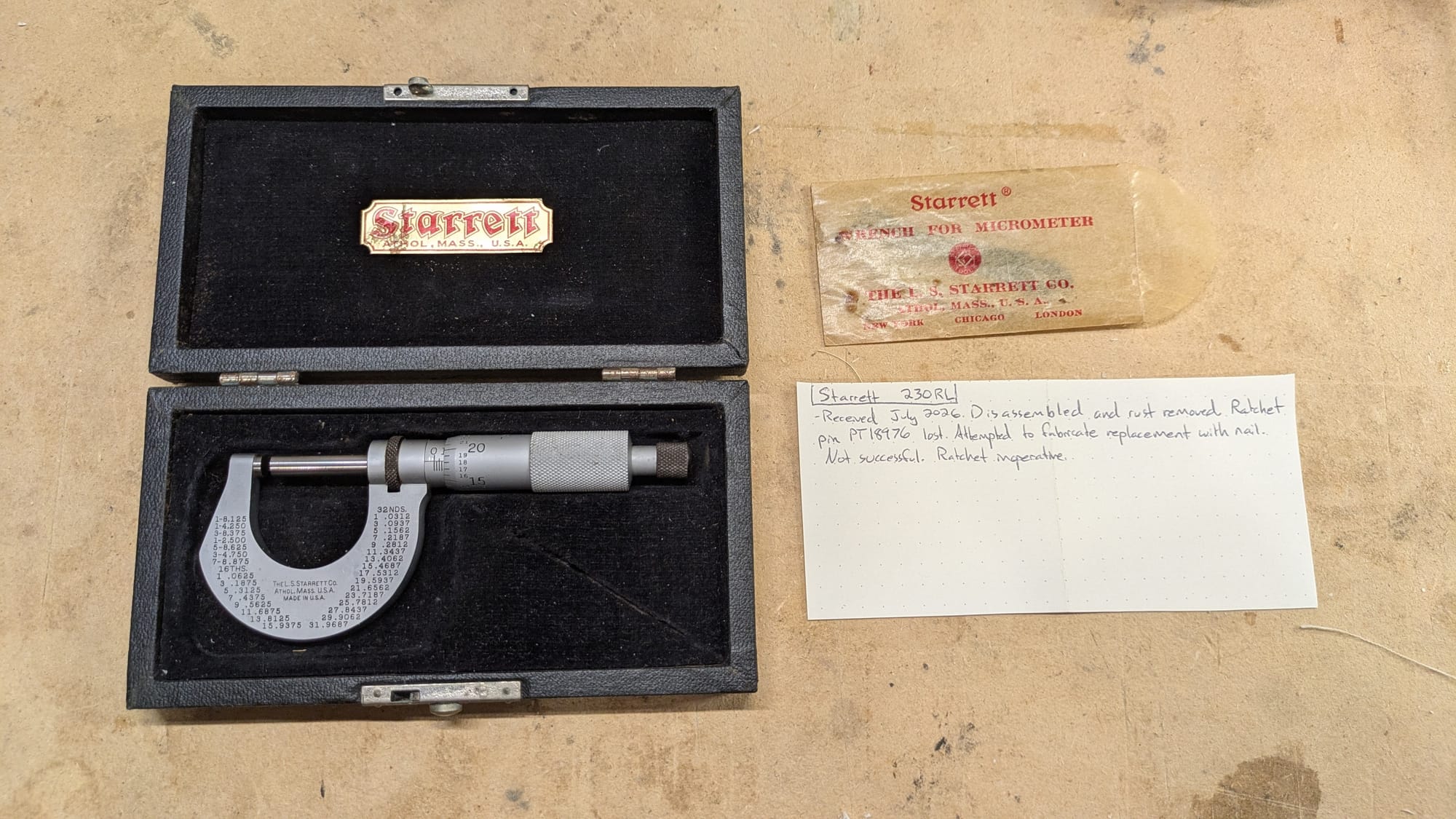
It arrived in this faux-leather case, lined with faux-suede, likely intended as sales packaging but perhaps not long-term storage in humid conditions. Here it is in the case, after cleaning off the rust from where it sat in contact with the (I'm sure moisture-retaining) case lining:
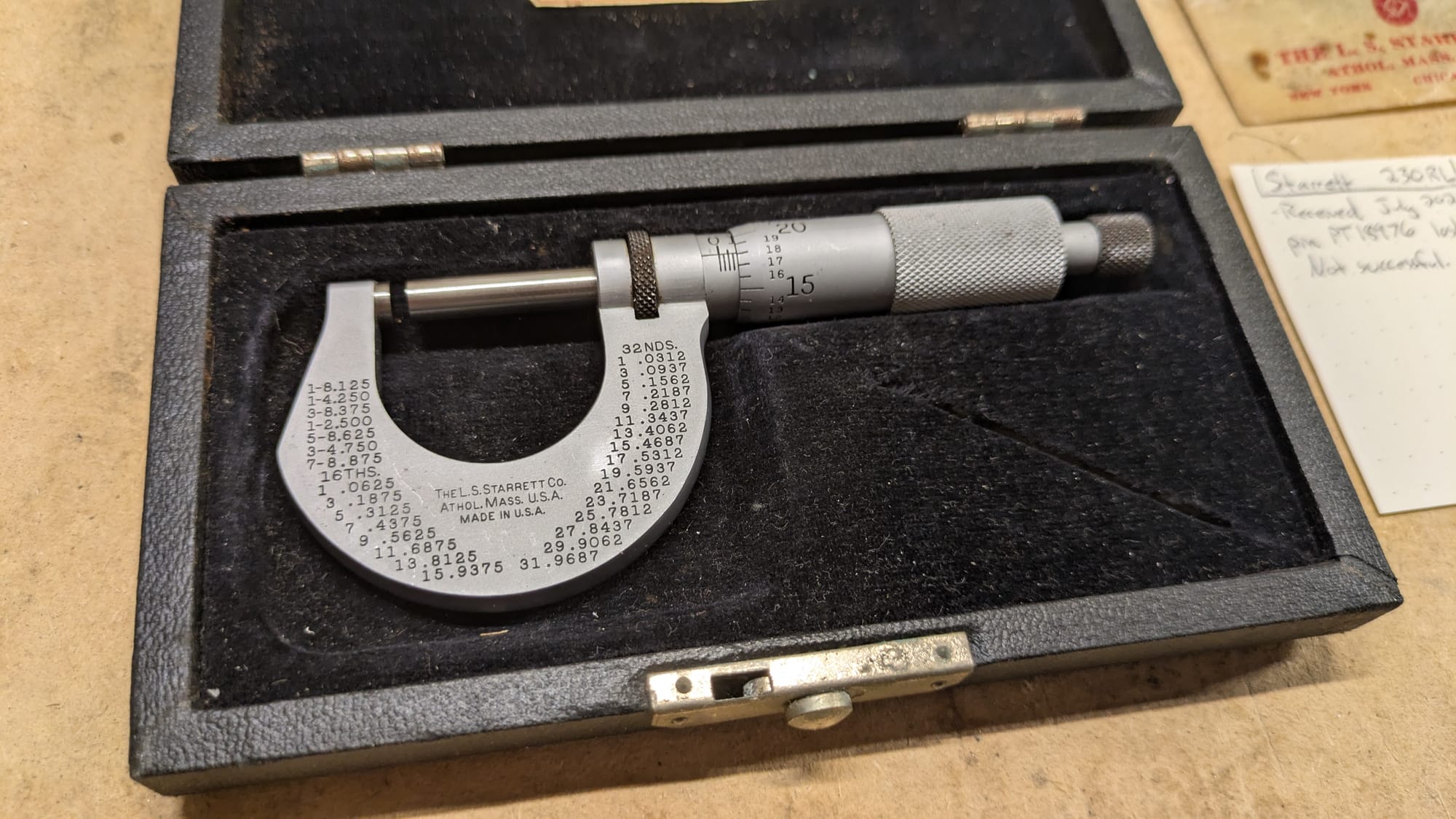
The auction listing didn't include specifics, but inspecting it, I found it is a Starrett No. 230RL
In an effort to not be precious about my tools, I started taking this one apart to try to clean off the rust and oil it for smooth operation. I was cautious taking it apart, but not overly concerned, thinking that it didn't have any springloaded parts likely to fly apart or anything too complex that I wouldn't be able to reassmble. So I carefully twisted and pulled and unscrewed and whole thing slowly came apart in a reasonable fashion.
The darker-metal, knurled parts that were left oxidized or blued had a good amount of surface rust. The lock nut ring in the body did not easily come out, but I was able to fully rotate it and clean it in place. The knurled tail cap, the driving part (I would come to understand) of the ratcheting mechanism, was held on with a flathead screw that was easily removed.
And sure enough, the small pin that sits under that cap, held by spring pressure, to provide the ratcheting action, proceeded to sproing its way out and out onto my workbench somewhere. The one part that could instantly and tracelessly disappear into the ether did exactly that.
Trying to imagine what a handy craftsman 60 years hence might have done, having no hope of identifying the part number of such a tiny pin much less having any hope of ordering a replacement in the days of paper catalogs, I looked around for what I had to fabricate a replacement.
The only metal stock of the right diameter I had was a simple mild steel nail.
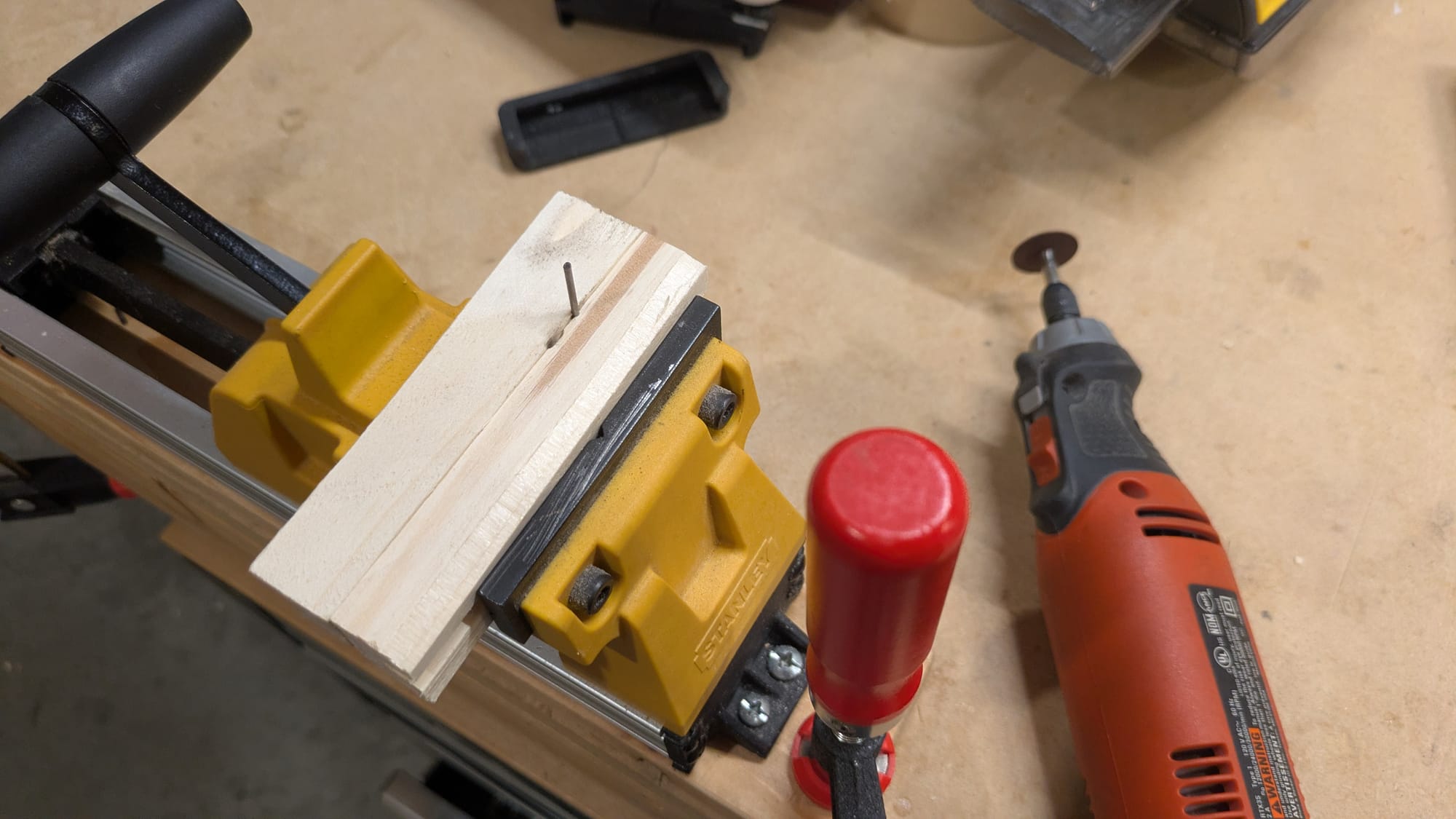
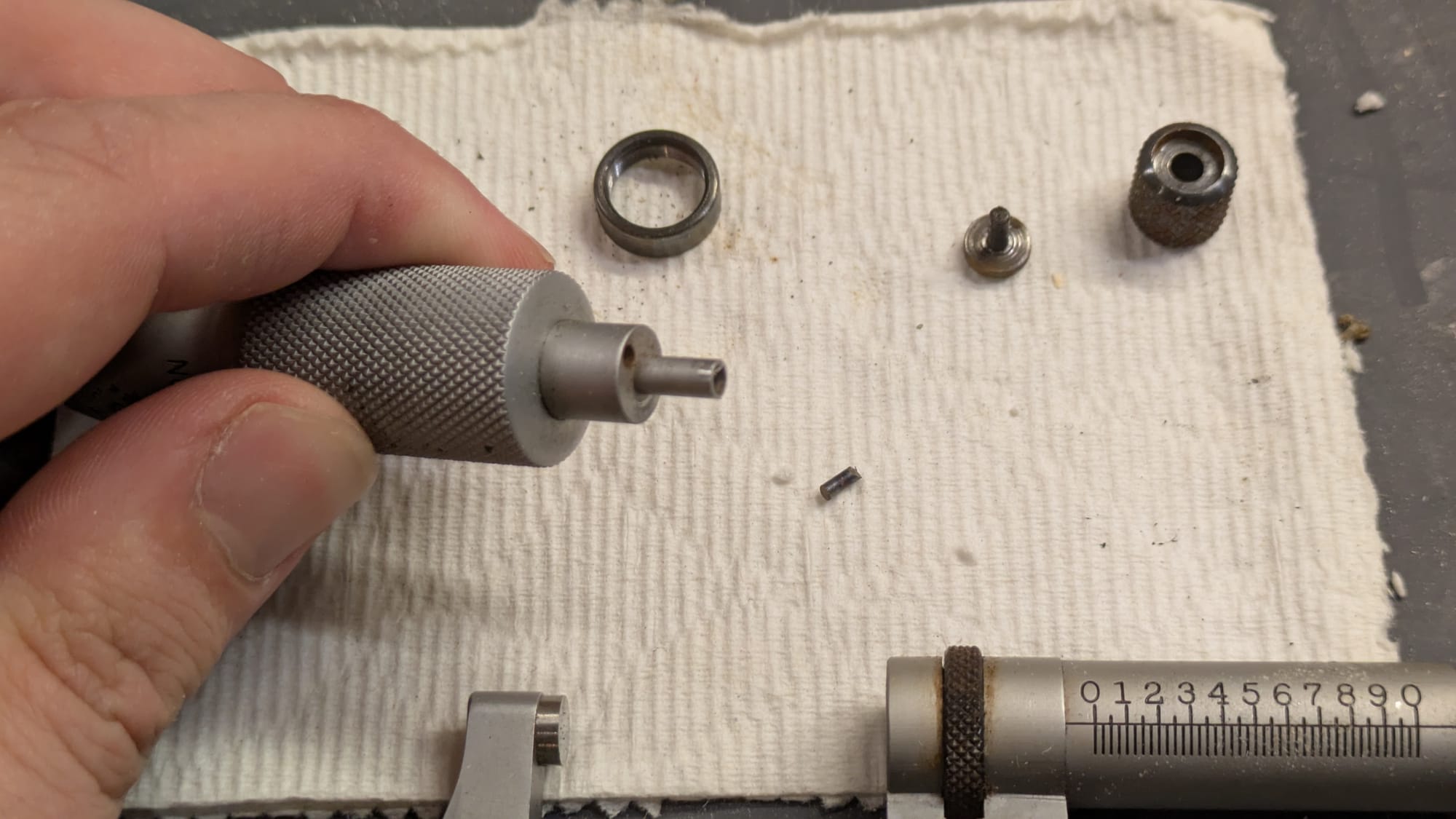
Predictably, the first attempt to cut off a short piece of the nail resulted in the cut off piece being propelled off the rotary cutoff wheel like a baseball from a pitching machine. Cutting a second replacement pin, this time holding the free end with pliers, and then shaping it with the cutoff wheel was more successful. The tailpiece made a satisfying ratcheting sound once I had cut the pin end at the right angle, but assembly revealed it did not develop the required pressure to effectively act as a ratchet. As soon as you went to tighten at all with it, it would slip and click. Fabricating two more pins that were longer and with different angles on the end proved unsuccessful.
However, the rust removal and oiling of the rest of the micrometer went uneventfully, and I got to figure out (with some brief internet searching) how the tension adjustment and calibration/zeroing[1] process worked.
The calibration relies on the ratchet working for exactly consistent tension, so the current calibration is approximate but should work for now. ↩︎
The part in question (PT18976 PIN, RATCHET .066D X .156L) is available from Starrett and other suppliers, so for $15 shipped I can rectify my carelessness. There's really no pressing need to fix the issue. In practice, the cheap digital calipers I bought more than ten years ago for reloading ammunition work just fine, and at functionally equivalent precision across a much wider range. So for now, the tool will live in my workbench (not in its case), and a note explaining my misconduct will live in the case.
Given that I bought this from an estate sale, I don't want to pass up the idea that the next person to try to use this tool may not be me, and may be befuddled about what I did to mess it up. At least they will have a handwritten confession.