Prototyping a vise jaw
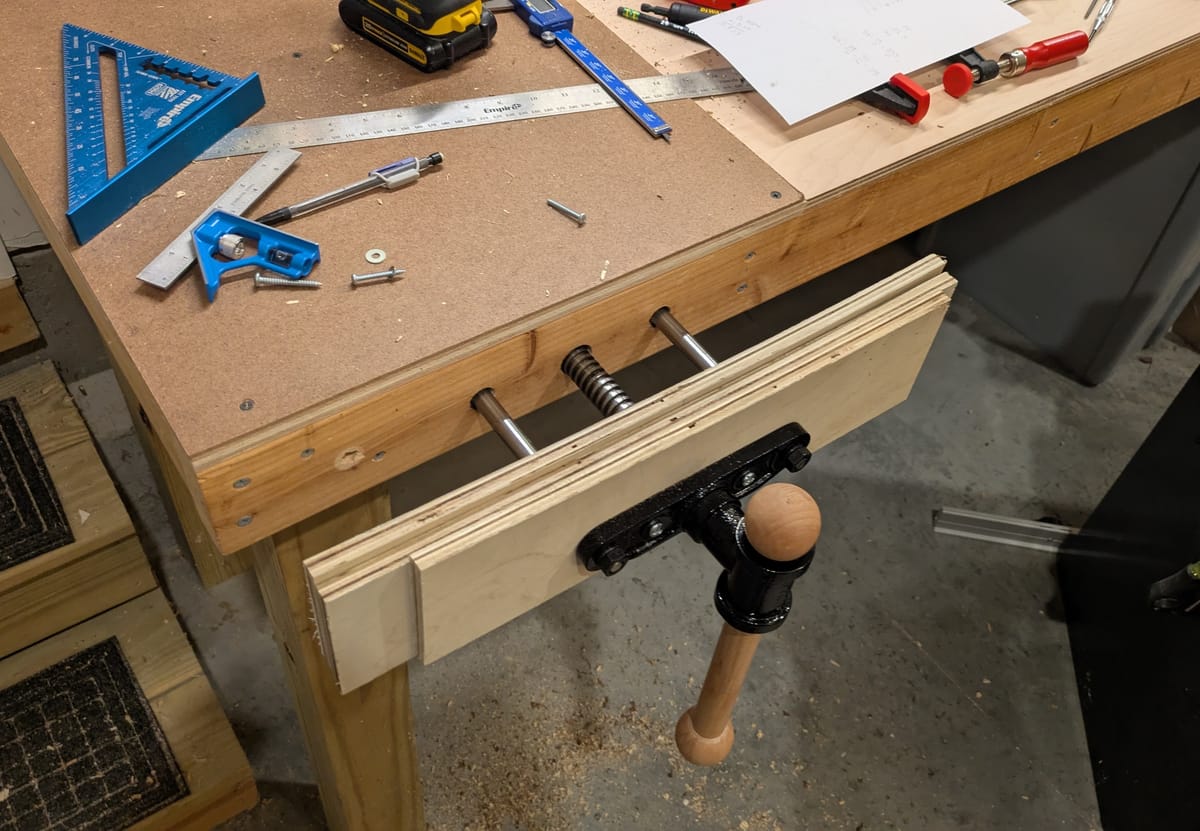
I'm installing a woodworking front vise. {Also known as face vise, distinct from leg vise, shoulder vise, or tail vise; those woodworkers are creative with names.} What I bought was just the metal frame, which you attach to the underside of your existing workbench and craft the jaw that holds the workpiece out of wood.
I bought a $25 piece of oak {Overpaying for a board of this size because of the convenience of getting it from Lowe's.} to be my jaw, but before I commit to cutting it up, I wanted to do some test cuts and prototypes.
The first prototype used scrap 1/2" plywood to test whether my drawing of the hole pattern to cut in the wood was accurate. After three iterations, I was satisfied. When the time comes to cut the holes in the oak, they will be sized and spaced properly.
Those three layer of plywood are screwed into the metal jaw to form the first prototype. I'm now using that first prototype to build a second prototype out of 1x4s which are more dimenisionally accurate to the oak I'll use for the final iteration.
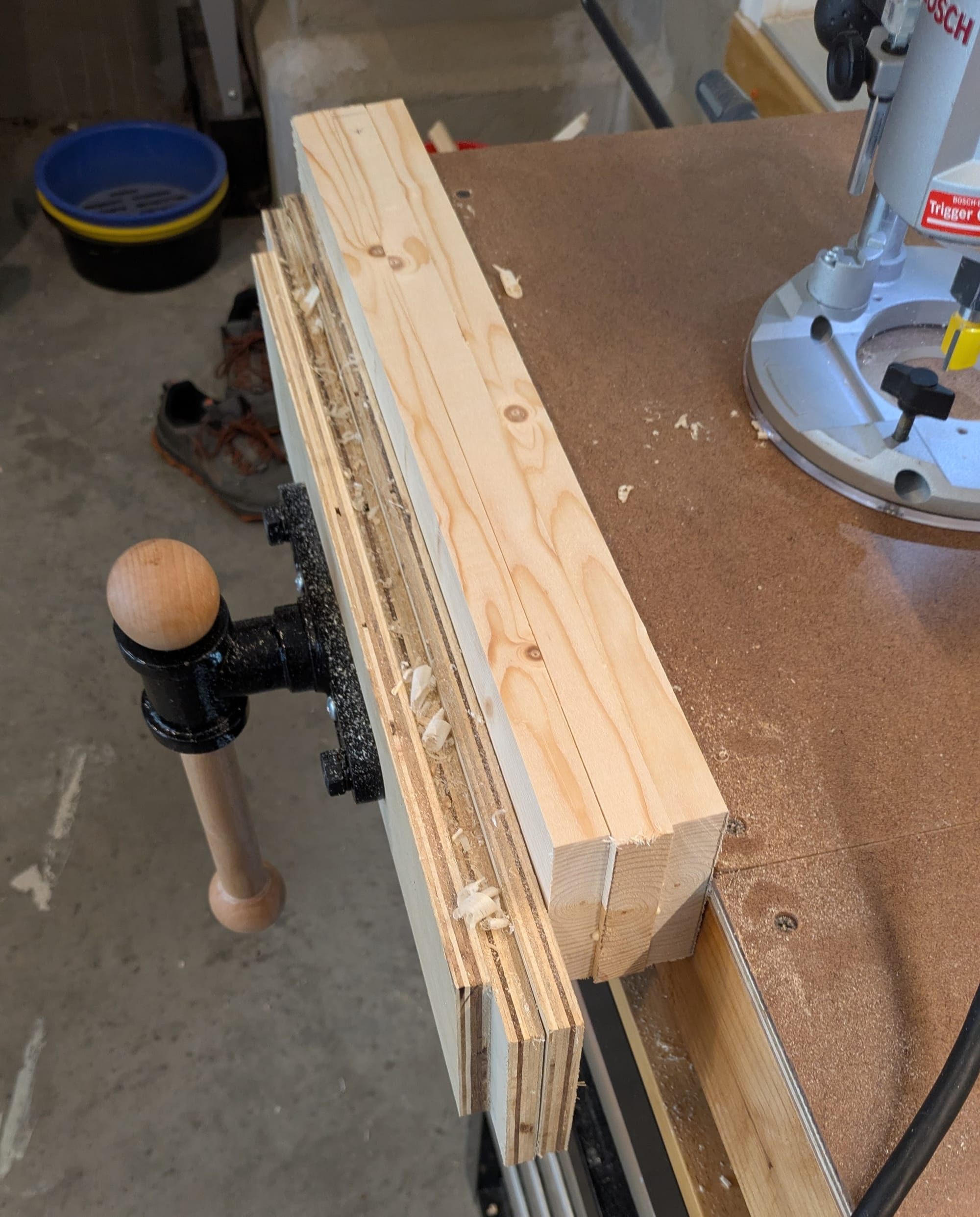
This pattern of building multiple iterations, expecting to throw them away, feels strangely wasteful to me. {Despite the fact that I know wood grows on trees.} In 3D printing, of course, it's unavoidable, and I've learned a few times that you need to just print a prototype first to hold it in your hands to immediately learn things you wouldn't find in an hour of staring at the screen.
In software engineering, there's the idea of minimum viable product (MVP) that gets used and misused often. We often think the minimum viable is way more polished than it needs to be. But each iteration teaches you something, and obsessing over the first iteration just prevents you from learning from it quickly and moving on. When the oak vise jaw is done, I hope it will be useful for a decade or more. Spending a day and a few prototypes to get it right in the grand scheme of things is not much.
I think this is emblematic of a larger, virtuous pattern. Nothing springs perfect and fully formed. Everything grows from the thing before it. It is not a sign of waste when something goes through multiple intermediary phases, as long as the trajectory is improving. It's a sign of care on the part of the craftsman that time has been taken to iterate on the thing instead of declaring the first iteration simply good enough and retiring.